


What must an ECE centre check before hiring a relief teacher in NZ?
Hiring and scheduling a relief teacher is almost a full-time job. For centre managers under time pressure — a reliever needed for tomorrow morning, a staff member off sick — it’s tempting to treat this as a formality. It isn’t. Placing an unvetted or lapsed-certification reliever is a licensing breach, a safety risk, and (if it surfaces during an ERO review) a black mark on the centre’s compliance record. Here’s the full breakdown.
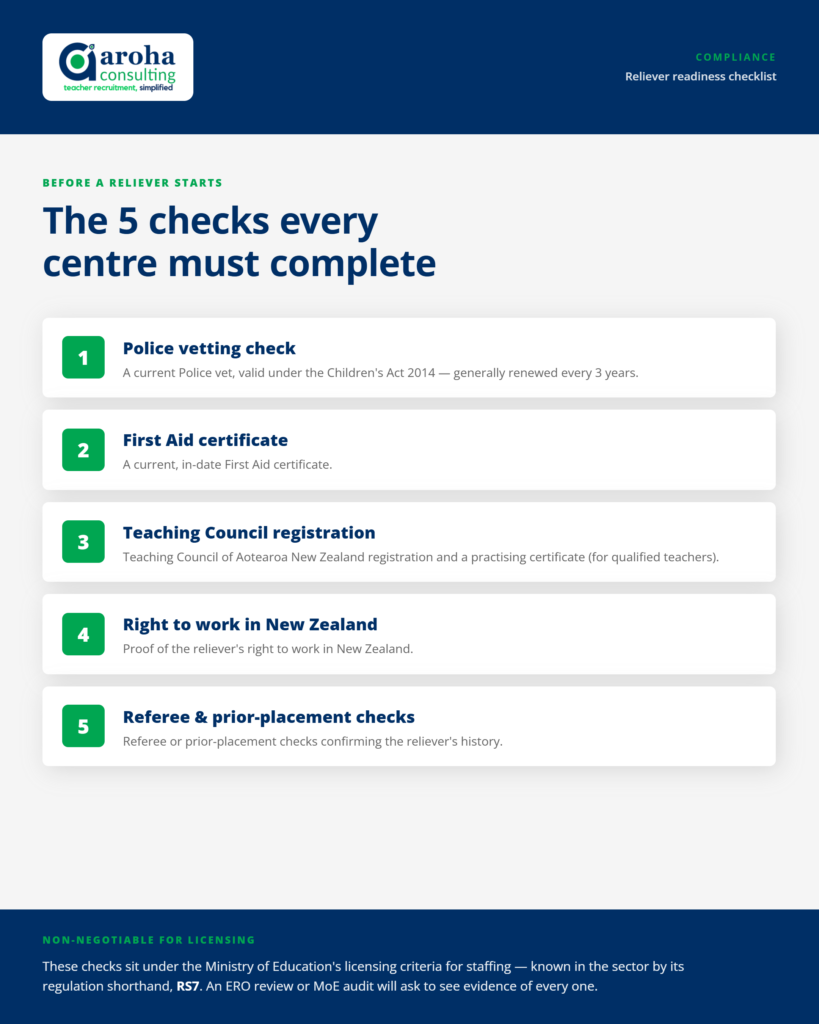
The 5 checks every centre must complete before a reliever starts
Before hiring a relief teacher, an ECE centre must verify five things:
1. Police vet (Children’s Act 2014 safety check)
Every person working with children in a licensed ECE service; including casual and relief staff must have a Police vet completed under the Children’s Act 2014’s core safety checking requirements. This isn’t a standard Ministry of Justice criminal check available to the public; it’s a specific children’s workforce safety check.
- Vets are typically valid for 3 years, but centres should confirm current guidance, as the practical refresh cadence can vary by provider policy.
- A reliever should never be placed with children before a valid vet is confirmed; “the paperwork’s in progress” is not sufficient.
- Agencies placing relievers across multiple centres (like Aroha Consulting) centralise this so individual centres aren’t re-vetting the same reliever repeatedly but the centre remains responsible for confirming the vet is current before the reliever is on the floor.
Centres must absolutely perform this step before hiring a relief teacher in NZ.
2. Current First Aid certificate
Relief teachers must hold a current First Aid certificate that meets ECE sector requirements (typically a comprehensive first aid unit standard covering infant and child CPR, not just a generic workplace first aid course). Certificates lapse; usually after 2 years — and an expired certificate is one of the most common gaps found in ERO spot-checks.
3. Teaching Council registration and practising certificate (for qualified teachers)
If the reliever is being placed as a “qualified” teacher for ratio purposes, the centre must confirm:
- Current registration with the Teaching Council of Aotearoa New Zealand
- A current practising certificate (registration alone isn’t enough – it must be an active practising certificate)
- No conditions, notices, or restrictions attached that would affect their eligibility to work unsupervised with children
This is checkable directly on the Teaching Council’s public register, and centres should do this themselves even when using an agency, since ratio compliance is the centre’s licensing obligation, not the agency’s.
4. Right to work in New Zealand
Standard employment law applies: the centre (or the agency placing the reliever) must confirm the person is legally entitled to work in NZ (NZ citizenship, residency, or a valid work visa with no restrictions) that would prevent ECE relief work.
5. Referee and prior-placement checks
Before hiring a relief teacher you must do your due diligence. Not always a licensing requirement in the strict regulatory sense, but standard due diligence is considered safe: confirmation of prior ECE experience, referee contact, and (where available) any record of prior placement issues. This is where a relief agency with an established roster and placement history rather than a cold hire off a job board; genuinely reduces risk for a centre.
Who is responsible – the centre or the agency?
Both, but ultimately the license-holder (the centre) carries the compliance obligation. When a centre engages relievers through an agency, the agency typically handles the vetting, qualification verification, and certificate tracking upfront; but a well-run centre should still confirm currency before a reliever is placed, particularly for Police vets and First Aid certificates, since these have expiry dates that can lapse mid-placement.
How Aroha Consulting handles this
Every reliever on the Aroha Connect roster is vetted, qualification-checked, and certificate-tracked before they’re eligible for placement and centres using Aroha Connect can see certification status at a glance rather than chasing paperwork centre-by-centre. If you’re a centre manager/owner wanting to see how this works in practice, get in touch or register directly as a Centre.
This article provides general guidance for ECE centre managers in New Zealand. It is not a substitute for current Ministry of Education licensing criteria or legal advice — always confirm requirements against official MoE and Teaching Council guidance.
A current Police vet under the Children’s Act 2014, a current First Aid certificate, Teaching Council registration and practising certificate (for qualified relievers), confirmed right to work in NZ, and referee checks.
The licence-holding centre carries ultimate compliance responsibility, even when an agency completes the vetting and placement process.
Typically every 3 years, though centres should confirm current requirements, as renewal cadence guidance can be updated.
No. Only relievers with current Teaching Council registration and an active practising certificate count toward qualified-teacher ratios.